
How We Got Here
On This Page:
- Budget Modification Overview
- Reductions Identified Across the University
- Summary of Current Proposed Budget Cut Preliminary Plan
- Enterprise Solutions
- Administrative Units
- Academic Inits
Budget Modification Overview
This preliminary proposal is informed by the working vision document, Toward a Premier R1 University, which was drafted to shape our conversations and guide our budget decisions. Drawing on the second principle outlined above to invest in research strengths, the working vision document outlines seven research confluences that identify signature areas of research where we aim to focus our ambition. The research confluences help focus our strategic approach to graduate education, particularly at the doctoral level. Drawing on the first principle to invest in the undergraduate educational experience, the working vision document emphasizes our commitment to offering undergraduate students distinctive experiences that empower them to discern who they are and what difference they hope to make.
The potential budget reductions we present below are being considered within the context of this emerging vision for the University of Oregon, which draws on and extends the priorities established in the Oregon Rising strategic plan.
We continue to invite feedback on the working vision document by email to otp@uoregon.edu.
Reductions Identified Across the University
Over the summer and fall, the university has been exploring avenues to close this deficit. Leaders have been working creatively, using this opportunity to develop long-term strategic proposals designed to put the university on a sustainable financial path rather than simply making across-the-board reductions. The proposals have been developed in response to feedback received during the initial period of consultation. Proposals have been developed in three broad categories: at the enterprise level, in administrative areas, and within the schools and colleges.
Summary of Current Proposed Budget Cut Preliminary Plan
The revised budget gap is $63.3 million, down from $65 million. $16 million comes from enterprise-level action through additional revenue, reduced strategic investment and reduced E&G transfers to support capital projects. After $3.9 million in prior deficit reductions, administrative units and schools and colleges share the remaining $43.4 million in reductions proportionally at an average of 7.25%. The cuts across the administrative and academic units will be implemented strategically, and not simply across the board at the department level.
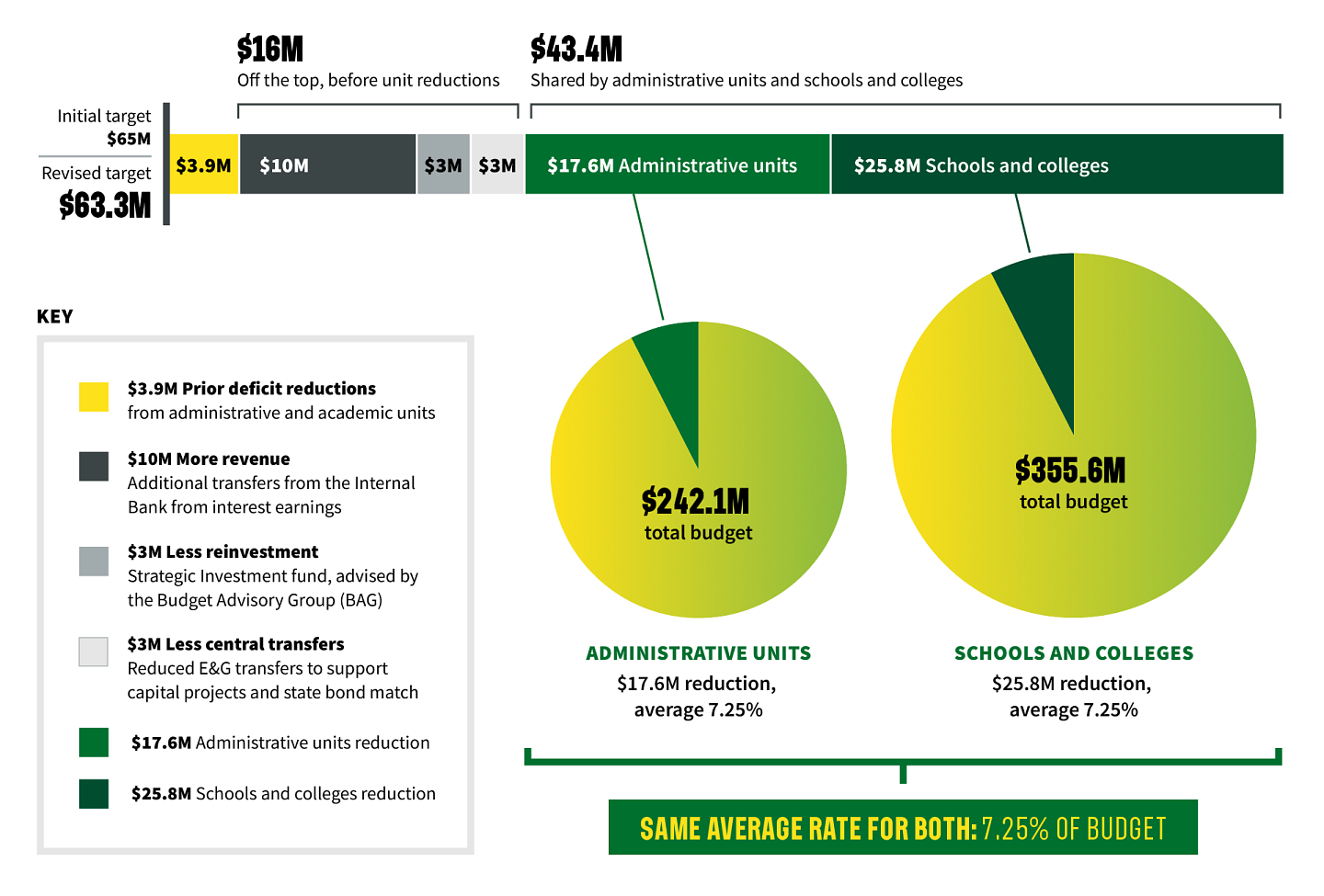
Circle areas are proportional to each budget.
Both reductions are an average of 7.25% of budget: 7.25% of $242.1 million equals $17.6 million;
7.25% of $355.6 million equals $25.8 million (rounded to the nearest $0.1 million).
Individual units will have varying reductions based on strategic need.
Enterprise Solutions
Over the last several months, President Scholz has tasked his leadership team to identify possible cost-saving opportunities at the enterprise level. Reductions at the enterprise level do not come without risks, but they have been proposed to minimize the impact of budget cuts on core academic programs and administrative services necessary to meet the university’s mission. With that in mind, the following proposed cuts are being considered:
Cut $3 million recurring from Budget Advisory Group (BAG) Strategic Initiative funds.
Historically, the institution has reserved $2 million per year in recurring funding to invest in critical initiatives. An advisory group of approximately 18-20 students, faculty, and staff annually reviews proposals from across the organization and makes recommendations to the president for funding. In recent years, the funding for these investments was reduced to $1 million recurring per year due to budget pressures. Examples of past initiatives supported through this process include the cybersecurity program, academic and career advisors, accommodations staff, environmental, health and safety staff, the Student Food Pantry and the Black Cultural Center.
The long-term projections assume that the UO will continue to invest $1 million of recurring funds per year in this process. This proposal would cut $3 million of this future assumed recurring funding and suspend the BAG process for three years. Previous investments will continue to be funded, but there will be no new funding during this time period. The main risk of this action is underinvestment in critical areas, as units that would historically have obtained Strategic Investment funds will have to either fund investments on their own (e.g., by cutting other programs or services to stay within their budget) or forgo the investment.
Cut $3 million recurring from E&G Fund Transfer Budget.
Funds are transferred out of the E&G fund budget for a variety of reasons, including to fund critical academic capital projects (e.g., faculty lab remodels), to provide the required match to qualify for state funding of capital projects (e.g., Lawrence, Friendly, Villard, and Huestis Halls); to make principal payments for debt on E&G-funded buildings; and to provide required matches for federal financial aid programs. The budget for E&G fund transfers in the current long-term projections is $13.2 million per year. The institution is considering reducing this budget by $3 million per year. While this will help balance the E&G fund budget, it risks leaving the institution without sufficient funds to invest in critical capital projects, including necessary match funding to receive state support for academic building projects.
Commit $10 million from Internal Bank—Strategic Investment Funds for E&G Fund Support
In recent years, with the implementation of new investment strategies and elevated market rates, the university has earned more on its cash and investment pool. Excess earnings beyond the standard rate distributed to campus (1.75% APR) are allocated to a one-time strategic investment fund. For many years, the cash and investment pool did not earn enough to allocate any funds to the strategic pool. Between FY18 and FY22, an average of $1.3 million was allocated each year. Because these returns are variable and not guaranteed, they have historically been used for one-time investments, with the majority being used for critical capital projects.
Starting in FY23, new investment strategies and a change in the rate environment have led to significant allocations to the fund (average of $23.25 million per year). The university is considering allocating $10 million recurring of this funding to E&G fund support, while reserving the balance to take care of two very large liabilities that will likely be occurring within the next four to six years: $33.2 million of debt on the White Stag Building in Portland and a necessary transition from Banner, the institution’s current legacy Enterprise Resource Planning (ERP) system. The estimated cost of the ERP transition is $50 million to $90 million depending upon the platform and extent of transition support needed. OSU is currently transitioning away from Banner at an estimated cost of $81 million. The risk associated with this budget allocation is that the market rate environment may change and there might not be enough funds generated in the future each year to support E&G activities and/or to meet these two very large upcoming liabilities.
Accounting and Human Resources Business Practices Advisory Group
The president has charged a cross-functional team with representatives from across the university – schools and colleges, auxiliary units, research centers and institutes, business hubs, and central departments – to explore changes to administrative functions that might result in more standardized business processes, more efficient delivery of service, as well as cost savings. As work of this group is still ongoing, with recommendations expected in four to five weeks, no savings are assumed from the initiative yet.
Strategic Sourcing
Purchasing and Contracting Services has launched a project working with colleagues across campus to assess the savings that can be had by better leveraging the institution’s scale to negotiate with vendors for improved product pricing. This project is still in the early stages and no savings are yet identified.
Administrative Units
In July and August, the vice presidents were asked to model 5%, 10%, and 15% cuts to their respective areas. Those models have been submitted for consideration and are being refined as administrative units continue to identify potential budget cut opportunities. Based on that initial modeling, it appears that across administrative areas we are likely to see reductions in staffing that affect particular services, rather than the elimination of entire departments. Early estimates project more than 100 Officers of Administration and classified positions will be affected, approximately 2/3 of which are occupied. Final decisions may vary area by area and will be made by President Scholz in early December.
Academic Units
Over the last few months, Provost Long has been working with deans and academic leaders across campus to develop recommendations for academic modifications. Deans were also asked to model 5%, 10% and 15% cuts to their schools and colleges. In order to provide meaningful consultative input to proposed academic modifications, the University Senate voted on May 27 to create the Academic Modifications Advisory Committee (AMAC) to act as the Senate’s designated body to provide feedback and input to the Provost and Provost’s Council.